

There was a time when being online felt like discovering something.
You might stumble across a personal website devoted to an obscure film, find a blog written by someone on the other side of the world, or join a conversation with people who shared an interest you could rarely discuss with anyone around you. The internet was messy, occasionally strange and often frustrating. But it had a sense of possibility. You never quite knew what you might find.
Now, increasingly, you know exactly what you are going to find. Outrage. Manufactured controversy. Influencers performing versions of themselves for an algorithm. AI-generated images and videos that blur the boundary between the absurd and the disturbing. Comment sections that may contain fewer actual people than we imagine.
We open our phones looking for something interesting and find ourselves caught in a system designed to keep us there.
I think that the question is no longer whether the internet has a problem. It is whether the version we have inherited is worth preserving.
The business of making us angry
In December 2025, Oxford University Press named “rage bait” its Word of the Year, reporting that use of the term had tripled over the previous 12 months.
It is a revealing measure of the moment. We have become increasingly conscious that much of what appears in our feeds is designed not to inform us, entertain us or even persuade us, but to provoke a reaction.
Anger works. So does disgust. So does the irresistible urge to correct someone who is obviously wrong. Every furious reply, quote-post and argument can become another signal of engagement. The platforms don’t necessarily care whether we leave the conversation better informed. They care whether we stay.
This creates a peculiar economy in which hostility becomes a product. Accounts profit from inflammatory claims, conspiracy theories and deliberately provocative content. Generative AI makes it easier to produce more of it, at greater speed and scale.
The result is a feedback loop. Content provokes anger, anger generates engagement, and engagement rewards the people producing the content. The system encourages imitation, so more accounts learn to behave in the same way. Content creators discover what works, so why not exploit that?
It is also very tempting to blame the people posting this material. Some deserve criticism. But the deeper problem is structural. When platforms reward attention regardless of its quality, bad behaviour becomes a commodity.
The decisions made by technology executives matter here. Changes to moderation policies can affect how easily harassment, hate speech and misinformation circulate. These are not inevitable consequences of technology. They are also consequences of choices about how platforms are run.
We have built an information environment in which being unpleasant can be a business model.
Are we talking to each other any more?
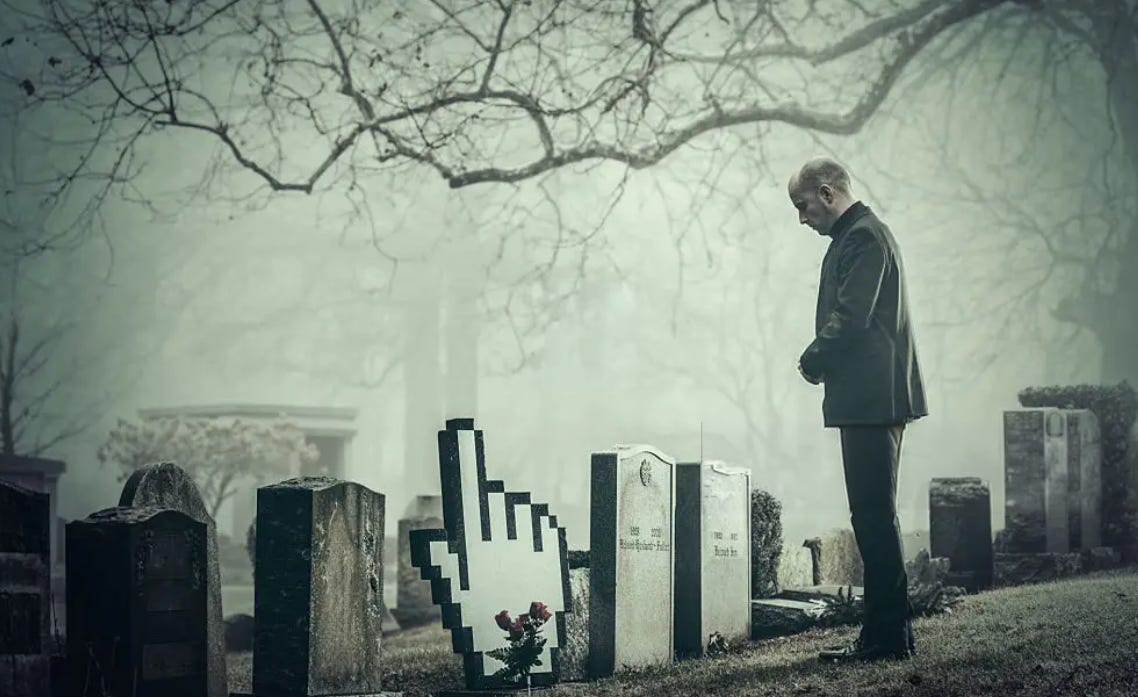
The images accompanying WIRED’s recent article Please Let the Internet Die make another unsettling argument: the web may be filling with activity that looks human but isn’t.
This is the territory of the Dead Internet Theory, the proposition that a substantial proportion of online activity consists of bots interacting with other bots rather than people communicating with one another.
The theory is often presented in its most extreme form, as though the internet has already become an entirely artificial place. That goes further than the available evidence can establish. But the underlying concern is worth taking seriously.
The WIRED article reports that one cybersecurity firm found automated agents already outnumbering human users, with their traffic surging by 8,000 per cent through 2025. That figure concerns the traffic measured in the firm’s analysis. It should not be confused with proof that 8,000 per cent of internet activity is artificial, or that most online conversations are fake.
Even with that qualification, the direction of travel is troubling. We are moving into a world where machines can generate posts, respond to comments, create images, imitate personalities and participate in conversations at a scale that humans cannot match. It becomes harder to know who is speaking, what their intentions are, or whether anyone is actually listening.
The social consequences are more significant than a feed cluttered with rubbish.
Online popularity has always been an unreliable measure of public opinion. Artificial engagement makes it even less reliable. A view that appears widespread may have been amplified by automated accounts. An apparent consensus may be manufactured. A furious argument may be sustained by people, bots or a mixture of both.
The danger is not simply that we might believe something false. It is that we might lose confidence in the possibility of genuine agreement altogether.
When every conversation could be manipulated, suspicion becomes the default.
We are losing the internet we thought we had
One of the most interesting aspects of WIRED’s article is its discussion of technologist and Pulitzer Prize-winning journalist John West’s book, The Internet Will Die, and So Will You: On Learning to Live in Our Digital Age.
Grim title, right, but West looks back at the personal web that developed from early home pages and online communities. These were spaces where people made things because they wanted to share them. Not everything was polished or attracted an audience. That was part of the appeal.
A website could be an expression of an individual’s interests, a record of a life or a meeting place for a small community. Its value did not depend on becoming popular.
Much of that internet has been neglected, commercialised or lost. Some personal websites survive as abandoned shells, cluttered with spam and broken links. Others disappear when a domain expires or a service shuts down.
West reflects on the strange unfairness of digital permanence: the things we want to preserve can vanish, while the things we wish would disappear forever can remain online indefinitely.
It is an observation that reaches beyond nostalgia.
We were encouraged to think of the internet as a vast, permanent library of human knowledge. But it is also a fragile collection of privately owned services, temporary websites and commercial platforms. What survives depends on decisions made by companies, publishers, institutions and individuals, many of whom have little incentive to preserve material that no longer makes money.
The scale of the problem is measurable. The images accompanying the WIRED article highlight research finding that 25 per cent of hyperlinks in The New York Times articles published between 1996 and mid-2019 were inaccessible.
A link is a small thing, until it is the only route to the evidence behind an argument. When links break, archives disappear and sources change, the record becomes harder to verify.
This is the contradiction at the heart of our digital lives. We leave traces of ourselves everywhere, yet the things we value are not necessarily the things that endure.
The algorithm has become our curator
There is another loss here, and it’s cultural. The early web offered the possibility of wandering. You followed a link, discovered an unfamiliar writer, read something unexpected and followed another path. You could spend an afternoon exploring a subject without needing to justify the time or turn the experience into a measurable achievement.
I think this may be my primary problem with big tech, we let them make decisions for us all the time.
There is nothing inherently wrong with recommendations. I love it when a friend suggests something they found and thought I would like it.
They can help us find music, books, films and ideas we would otherwise miss. The problem arises when the commercial value of a recommendation takes precedence over its cultural value.
A quiet essay may be more thoughtful than an inflammatory video. A small literary journal may offer more nourishment than an influencer’s latest provocation. A conversation between five people who genuinely care about a subject may be more meaningful than a post seen by half a million strangers.
But the system cannot easily translate those differences into the metrics it rewards.
The result is a narrowing of experience cleverly disguised as endless choice. We are offered more content than ever, while the same formats, personalities and arguments circulate repeatedly. The feed keeps moving, but our horizons do not necessarily expand.
And we have learnt to participate in the system ourselves. We measure our reading, our creative work and sometimes our relationships through likes, views, followers and streaks. We can begin to value an experience less for what it gives us than for whether it can be displayed and counted (it feels like every episode of Black Mirror taught us that).
The internet’s logic seeps into the way we think about our own lives.
The problem with nostalgia
It would be easy to turn this into a lament for a lost golden age. That would be too simple. But lamenting the passing of those niche little reviews of films or a collection of essays in Science fiction authors is something of a regular pastime these days.
It’s not that the early internet was an egalitarian paradise. It still contained harassment, prejudice, misinformation and exclusion, it was just easier to ignore because it wasn’t fed to you constantly through a hungry algorithm. I remember well that the 1995 film The Net starring Sandra Bullock posited the internet would be the end of privacy and stealing data would become commonplace, that now seems very quaint and naive.
And it’s not that the commercial internet was ever free from commercial interests. Advertising, data collection and the pursuit of growth have shaped the web for decades.
What has changed is the scale and sophistication of the machinery, along with the dominance of a small number of platforms over how people discover information and communicate. Generative AI adds another layer, making it cheaper to produce vast quantities of content, whether or not that content contributes anything useful.
The answer cannot simply be to return to 1995.
But we should be able to distinguish between the internet’s genuine achievements and the business models that have come to dominate it.
The ability to communicate across distance, share knowledge, publish without a traditional gatekeeper and find people who understand our particular interests remains extraordinary. Those things are worth protecting.
The question is whether they need to remain attached to platforms that treat our attention as a resource to be extracted.
What if we stopped trying to save it?
The provocative title of the WIRED article, Please Let the Internet Die, is not really an argument for switching it off. It is an argument against treating the present arrangement as inevitable.
The internet is not one thing. It is a collection of technologies, institutions, communities and commercial interests. The decline of one version does not have to mean the end of all the others.
Perhaps the more useful response is to stop confusing the major platforms with the internet itself. There are independent websites, small forums, newsletters, digital archives, creative communities and online journals that exist without trying to maximise every interaction. They are often less visible precisely because they are not built around the same attention economy.
They may not have the reach of the major platforms. They may not offer the same convenience. But they can create conditions for something the algorithmic feed struggles to provide: sustained attention between people who have chosen to be there.
This is one reason I find the idea of independent publishing so compelling. A small publication can give an idea room to develop without demanding that it become a viral moment. A reader can spend time with a piece of writing without being immediately directed towards the next outrage.
That is not a complete solution. Independent spaces still need to be funded, moderated and maintained. They can also reproduce the same problems if they chase growth at all costs. Simply moving to a different platform does not automatically make our digital lives healthier.
But it gives us somewhere to start. We can choose what we publish, where we read, whose work we support and which forms of engagement deserve our time. We can value a thoughtful exchange over a large audience. We can build archives, support independent writers and preserve work that would otherwise be lost.
The ghosts in the machine
There is something fitting about WIRED publishing ghost stories alongside this argument.
The internet is full of ghosts. Abandoned profiles belonging to people who have moved on. Websites that no longer work. Old posts preserved long after their authors have forgotten them. Online communities that survive as fragments of something that once mattered. Like digital skeleton’s dangling in long forgotten closets.
Now there are new kinds of ghosts: synthetic personalities, automated conversations and content produced without any particular human experience behind it.
The distinction between a ghost and a living presence has always been about more than whether something can be seen. It is about whether someone is there.
That question feels increasingly relevant when you can have a million views and no meaningful conversation. An endless supply of content and very little worth remembering. And we can be connected to everyone and still struggle to find a place where we belong.
Perhaps this is what the internet’s current crisis reveals. Connection was never the same thing as engagement, and information was never the same thing as knowledge.
The internet does not need to die. But the version of it that treats human attention as an inexhaustible commodity deserves to lose its grip for sure.
Let the rage bait fade. Let the artificial popularity collapse. Let some of the enormous platforms discover that people are no longer willing to give them every spare moment of their attention.
And let us build something smaller, stranger, more generous and more human in the spaces that remain.
Not because the past was perfect, but because the future is still ours to make.
The question is not whether we can save the internet as it is. It is what we want to preserve when this version of it finally passes.
This article is based on themes explored in Miles Klee’s WIRED article, “Please Let the Internet Die,” published 28 October 2026, and John West’s book, The Internet Will Die, and So Will You: On Learning to Live in Our Digital Age.
Read the original article: Please Let the Internet Die – WIRED